Your child has a science fair. You are not a scientist. This is the bit that helps.
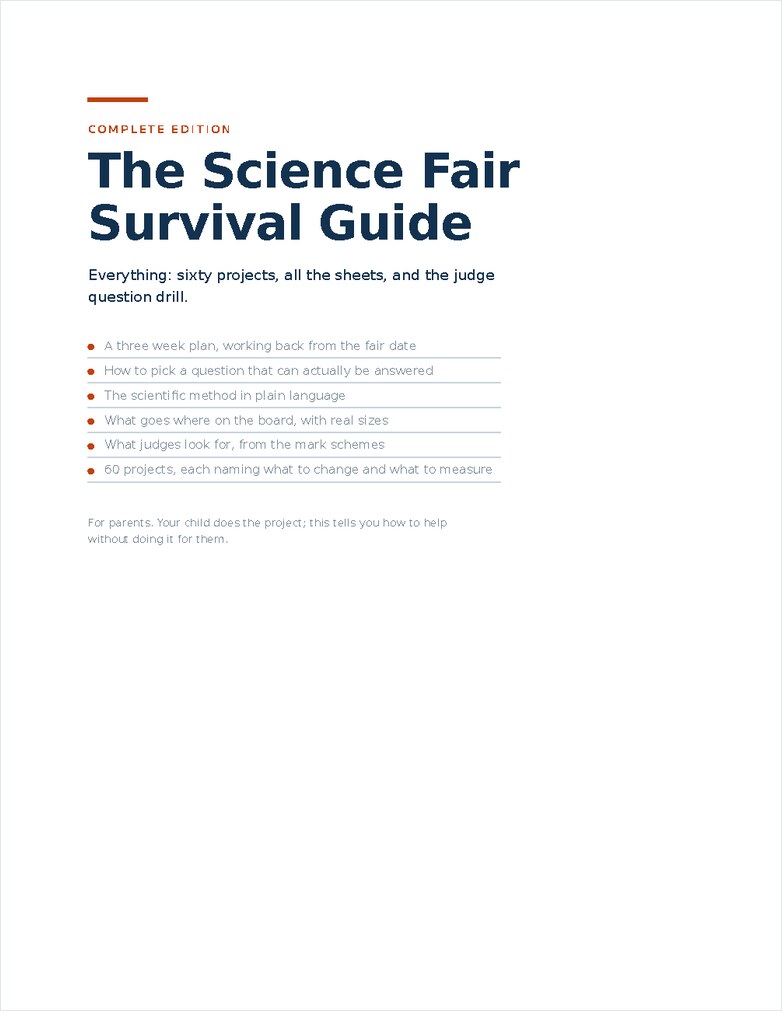
A guide written for parents, not teachers: how a science fair project actually works, a three week plan that works backwards from the date, and projects your child can run themselves with things from a supermarket.
Because the usual problem is not ability. It is that nobody told you a volcano is a demonstration rather than an experiment, and the fair is on Friday.
Pick a version
Starter
If the fair is weeks away and you mostly need to know how this works.
- The full guide, 16 pages
- 15 projects
- Three week plan
- Board layout and sizes
- What judges look for
- Three day rescue plan
Standard
The sheets are the part parents say they wanted. This is the one most people take.
- Everything in Starter
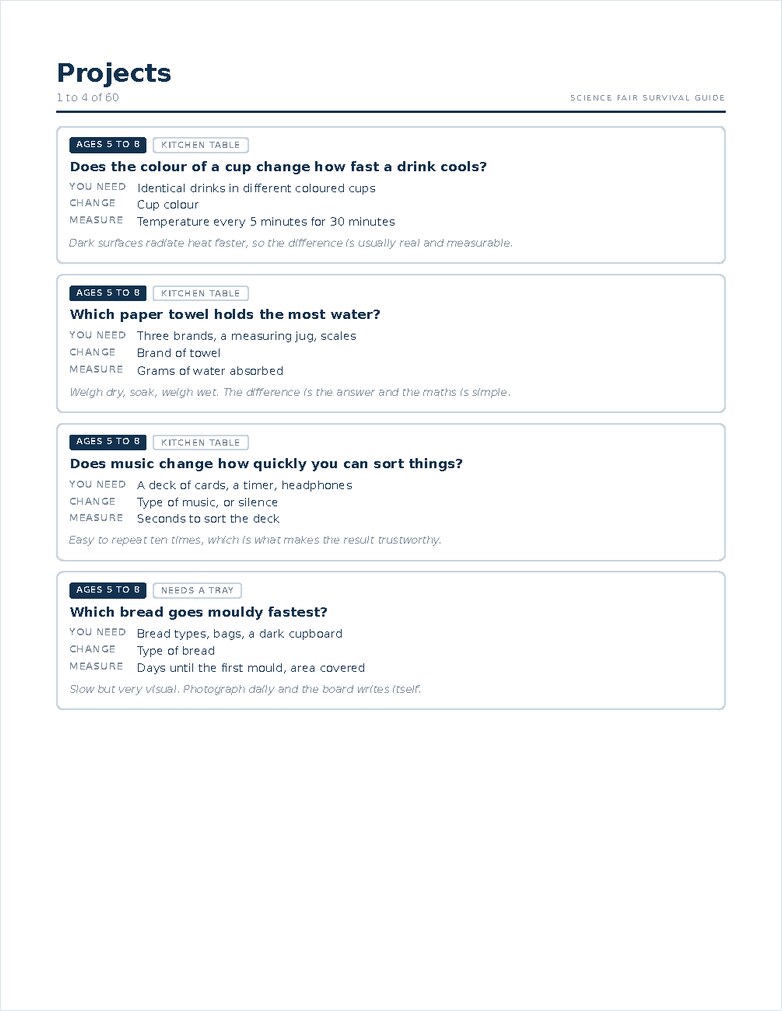
- 40 projects
- Planning sheet
- Results table and averages
- Observation log
- Report template
- Board layout sheet
- Week before checklist
Complete
If you would rather have the whole thing and not wonder what is in the other one.
- Everything in Standard
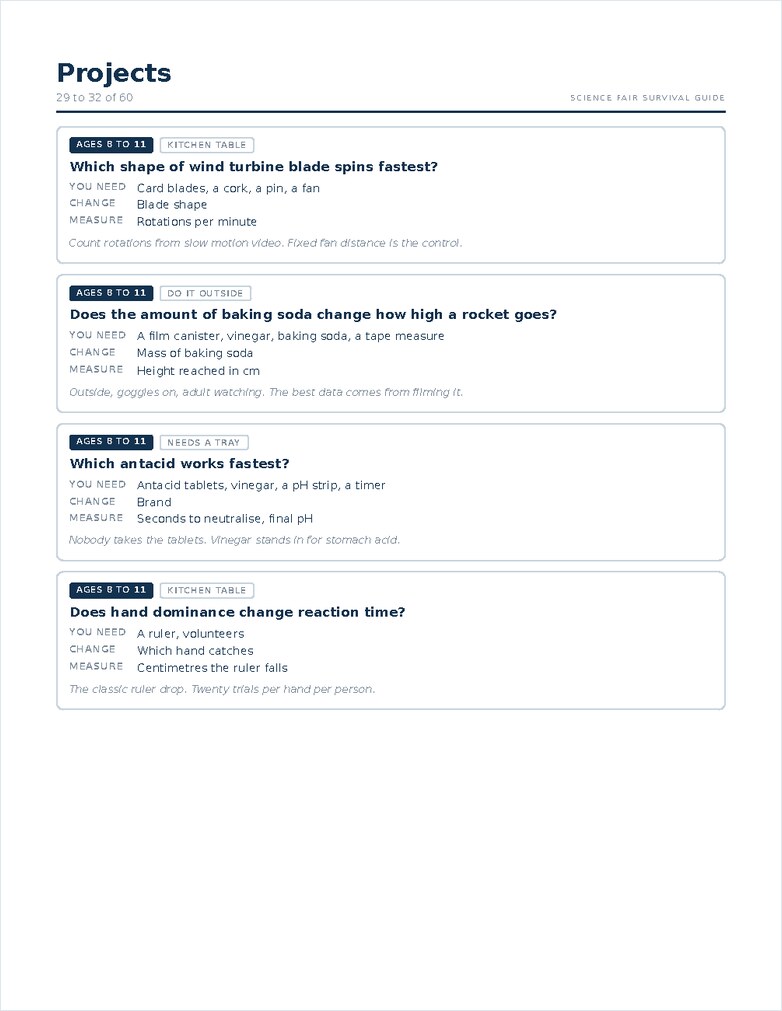
- 60 projects, ages 5 to 14
- Judge question drill
- All ten likely questions
- Projects marked for mess
- Both paper sizes
What is inside
The one mistake
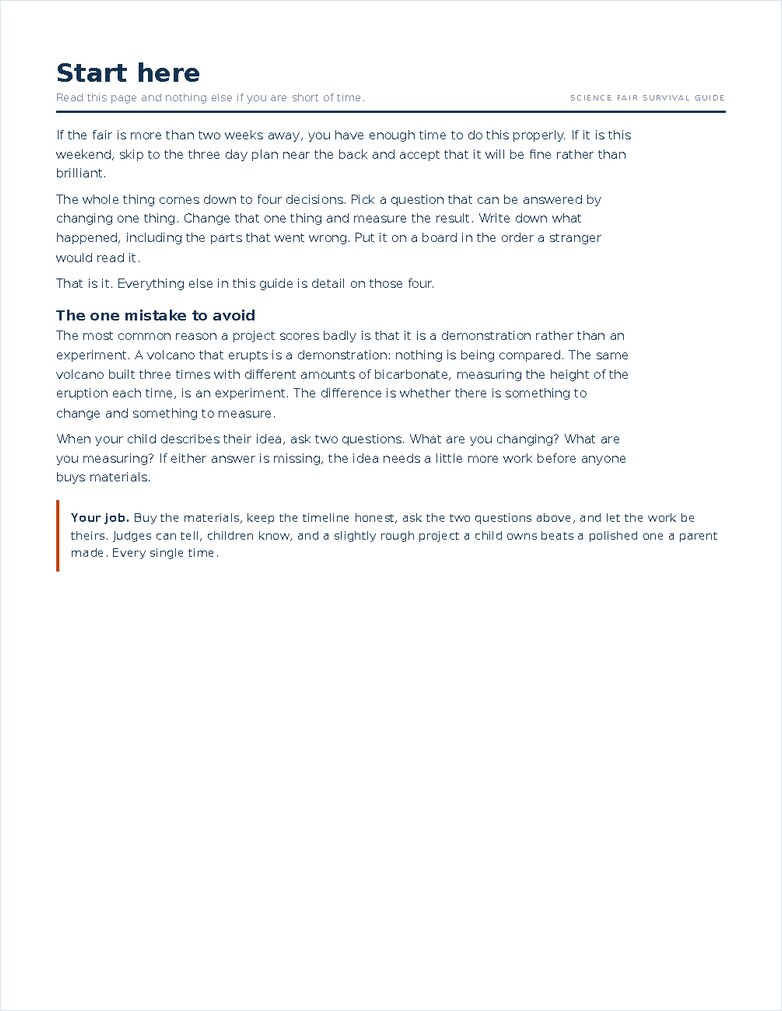
The commonest reason a project scores badly is that it is a demonstration rather than an experiment. A volcano that erupts is a demonstration; nothing is being compared. The same volcano built three times with different amounts of bicarbonate, measuring the height each time, is an experiment.
When your child describes their idea, ask two questions. What are you changing? What are you measuring? If either answer is missing, the idea needs a little more work before anyone buys materials.
What judges actually weight
Presentation and neatness are usually the smallest part. The largest, by a long way, is whether the child understood it, which is why they have to do the work themselves.
After that: was one variable changed, were controls listed, were there enough repeats, and is the data honest, anomalies kept and discussed rather than quietly removed.
Questions
- What exactly do I get?
- A PDF sized for US Letter and the same sized for A4, downloaded straight after payment. 16 pages in Starter, 28 in Standard, 34 in Complete.
- Is this for my child to read, or for me?
- For you. It is written for a parent who wants to help properly without taking over. Your child can read the project pages happily, and most do.
- What age is it for?
- The projects are marked in three bands, roughly 5 to 8, 8 to 11 and 11 to 14. The guide itself applies at any age.
- Does it come with a kit?
- No. Every project uses things you can buy in a supermarket, which is deliberate: a project built from a kit is harder for a child to explain and judges notice.
- Our fair is in three days.
- There is a three day plan near the back, and projects marked kitchen table that can be run in one evening. A small finished project beats an ambitious unfinished one every time.
- Which version should I get?
- Standard, for most people. Starter if you mainly want to understand how it works. Complete if you would rather have everything and not wonder.
- What if it is not what I expected?
- Email us and we will refund it.